A

Sunday, June 10, 2018

THE FACTORS BEHIND POWER LOSS IN AN ENGINE

Most operators lacks the proper knowledge on how to use and maintain an engine. Knowing the requirements for an engine to produce power and other function are important factors that must be learned in engine maintenance.  

Humans are mostly ignorant of the sign of power loss that emanate from the engine even when they are sometimes pronounced. For an engine to produce or loss power there are four factors that must be consider


  • AIR
  • FUEL
  • COMPRESSION
  • SPARK PLUG
AIR
Generally, in the absent of air, combustion of fuel can not occur. The mixture of air and fuel, known as the charge is a major factor for an engine to produce power,in absential power can not be generated.
Air contains dust,dirt particles and other contaminants of which if drawn into the injector, it causes blockage of  the injector nozzle and the running jet of the carburetor. in cases like this, the air filter is applied to prevent the dirt and contaminant from flowing through to the mixing chamber.

The air filter when applied prevents dirt from flowing through. The prevented dirt thereby remains in the air filter and hence clogging follows.A clogged air filter makes the engine work harder to pull in air, and can restrict the maximum amount of air intake. Less air means less power. 

Problems like this can be easily fixed, either by cleaning or replacing. Be bold it does not require a tool.

Another factor under air is the THROTTLE CABLE or ACCELERATOR CABLE, over time, due to long usage the throttle cable may loose or break. Breakage or failure of the throttle cable affects the ability of the engine to produce power due to the inability of the cable to open the throttle usually a butterfly valve for air intake. 
The exhaust port is also one factor that reduces the power of an engine if not properly maintained. The burnt gases in the combustion chamber flows through the exhaust port to the surrounding. clogging occurs sometimes of which restricts the flow of burnt gas hence causing to engine more power to push it out. Also clogging of the catalytic converter and mufflers can reduce an engine performance.


FUEL
The fuel system will support the engine, if the fuel injector/carburetor and the fuel pump are in good condition. For injectors, the system can be clogged up when deposits are built up as a result of heat soak or bad fuel injected into the system, thereby causing improper air-fuel mixture ratio and misfiring of the engine.

 The pump which is the fuel metering system can wear or struggle overtime due to its inability to measure up to the demand of long distance travel and higher load. These are the major factors under fuel that causes an engine to loss power.

COMPRESSION
Improper sitting of the compression rings reduces the power of an engine. This occur over time as a result of worn out component of the engine and this allows leakage of charge between the piston and the cylinder wall into the crankcase[blow-by]. That means pressure lost,compression lost and hence power loss.

Another factor is deposits on the valve sitting and improper arrangement of the timing belt which controls the movement of the camshaft and crankshaft as related to the valves. These effect on the valve cause low compression,additional restriction for the charge to come by and back firing. When these are detected,then there is every tendency that there will be loss of power in the engine.


SPARK PLUG
The spark plug supplies the spark that is needed for combustion to be initiated. Deposits from lubricants,fuel and carbon deposits causes inconsistent spark plug firing. Maintaining a high spark, ensures high power output but low spark as a result of deposits will result to loss of power.

NB:
 Carbon deposit on the cylinder wall or the piston can create hot spot and these hot spot will result to engine knock. sometimes it will retard the ignition timing to reduce the possibilities of knocking if the engine is capable. These process of retarding the ignition timing, power is lost in the engine. Proper lubrication plays an important role in this.


Saturday, June 2, 2018

THE TURBOCHARGER SERIES


The value of the turbo charger in an automobile is unknown to a few engineers and its users, because they lack the proper knowledge on these points of the component itself.


Image result for turbocharger
http://d3e98kcom2u4ch.cloudfront.net/wp-content/uploads/oldblog/2016/09/turbocharger-operation-diagram.jpg


  • What is the value of the turbocharger?
  • What is it made of?
  • How does it work?
  • Where can it applied?
  • Likely problem encountered


Ignorantly we think the main reason motor A generates more power,higher velocity,consumes less fuel, sometimes environmental friendly than motor B is because of the engine structure or size. But there is one way to improve an engine which is the turbocharger.

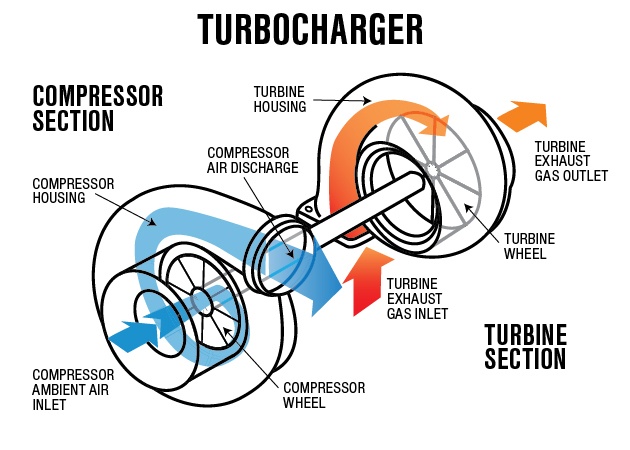
The turbocharger is an exhaust-gas driven component of an engine that increases the volumetric efficiency of air in an engine in order to increase its power.  It consist of a casing,impellers and shaft.

Generally, the charge[mixture of fuel and air] that flows into the combustion chamber produces the torque that turns the engine. For the engine to produce or generate more power there are two alternatives, firstly, is to increase the size of the engine[the cylinder block,cylinder wall,pistons] so that the total volume of intake increases. The second option is to generate air externally.

Several medium can aid the supply/generating of air into the engine, of which, are the supercharging,turbocharging and others.The turbocharger is of advantage over the supercharger because it uses the exhaust gas of the engine to power the impellers thereby generating the air needed whereas the supercharger uses the crankshaft of the engine connected via belts to power it blades.

Some might ask, of what importance is the turbocharger aside increasing the torque that turns an  engine, ok, here it is

  • It reduces the stress of an engine by decarbonizing
  • It cleans the combustion chambers
  • It adds 20hp to the engine
  • The turbo charger acts like a silencer
  • It reduces the stress of the valve
  • It increases the power of the engine with less fuel

WHAT IS IT MADE OF?

The turbocharger consists of a compressor and a turbine. The compressor and the turbine consist of impellers and are connected via a shaft.

The impeller in the turbine is responsible for the discharging of pressure in the engine and also sucks out the exhaust gas while the impeller of the compressor receives the exhaust gas. The compressor and turbine of the turbocharger are connected via a shaft which controls and enable smooth rotation.


HOW DOES IT OPERATE? 

It operates with a simple principle. It uses the exhaust gas to drive the turbine which spins the compressor hence pushes extra air[oxygen,densed] into the cylinders,allowing them to burn more fuel each second.

The turbine and the compressor consist of impeller which are connected via a shaft that enables them spin alongside.
The turbine is connected to the exhaust manifold. When hot gases passes through the impellers of the turbine they rotate as well as the shaft hence causing the impellers of the compressor to rotate. As the impellers in the compressor of the turbocharger which is connected to the intake manifold rotates, it draws air into the engine and forces it into the cylinder through an heat exchanger.
Note:the heat exchanger is used to make the air cooled and denser.


WHERE CAN IT BE APPLIED

It can be installed in the otto cycle engines and Diesel cycle engines


LIKELY PROBLEM ENCOUNTERED

  • Grinding of shaft
  • seizing of shaft from rotating. This can lead to overheating of the turbocharger itself.