Most operators lacks the proper knowledge on how to use and maintain an engine. Knowing the requirements for an engine to produce power and other function are important factors that must be learned in engine maintenance. Humans are mostly ignorant of the sign of power loss that emanate from the engine even when they are sometimes pronounced. For an engine to produce or loss power there are four factors that must be consider
AIR
FUEL
COMPRESSION
SPARK PLUG
AIR Generally, in the absent of air, combustion of fuel can not occur. The mixture of air and fuel, known as the charge is a major factor for an engine to produce power,in absential power can not be generated. Air contains dust,dirt particles and other contaminants of which if drawn into the injector, it causes blockage of the injector nozzle and the running jet of the carburetor. in cases like this, the air filter is applied to prevent the dirt and contaminant from flowing through to the mixing chamber. The air filter when applied prevents dirt from flowing through. The prevented dirt thereby remains in the air filter and hence clogging follows.A clogged air filter makes the engine work harder to pull in air, and can restrict the maximum amount of air intake. Less air means less power. Problems like this can be easily fixed, either by cleaning or replacing. Be bold it does not require a tool.
Another factor under air is the THROTTLE CABLE or ACCELERATOR CABLE, over time, due to long usage the throttle cable may loose or break. Breakage or failure of the throttle cable affects the ability of the engine to produce power due to the inability of the cable to open the throttle usually a butterfly valve for air intake. The exhaust port is also one factor that reduces the power of an engine if not properly maintained. The burnt gases in the combustion chamber flows through the exhaust port to the surrounding. clogging occurs sometimes of which restricts the flow of burnt gas hence causing to engine more power to push it out. Also clogging of the catalytic converter and mufflers can reduce an engine performance. FUEL The fuel system will support the engine, if the fuel injector/carburetor and the fuel pump are in good condition. For injectors, the system can be clogged up when deposits are built up as a result of heat soak or bad fuel injected into the system, thereby causing improper air-fuel mixture ratio and misfiring of the engine. The pump which is the fuel metering system can wear or struggle overtime due to its inability to measure up to the demand of long distance travel and higher load. These are the major factors under fuel that causes an engine to loss power. COMPRESSION
Improper sitting of the compression rings reduces the power of an engine. This occur over time as a result of worn out component of the engine and this allows leakage of charge between the piston and the cylinder wall into the crankcase[blow-by]. That means pressure lost,compression lost and hence power loss.
Another factor is deposits on the valve sitting and improper arrangement of the timing belt which controls the movement of the camshaft and crankshaft as related to the valves. These effect on the valve cause low compression,additional restriction for the charge to come by and back firing. When these are detected,then there is every tendency that there will be loss of power in the engine.
SPARK PLUG
The spark plug supplies the spark that is needed for combustion to be initiated. Deposits from lubricants,fuel and carbon deposits causes inconsistent spark plug firing. Maintaining a high spark, ensures high power output but low spark as a result of deposits will result to loss of power.
NB:
Carbon deposit on the cylinder wall or the piston can create hot spot and these hot spot will result to engine knock. sometimes it will retard the ignition timing to reduce the possibilities of knocking if the engine is capable. These process of retarding the ignition timing, power is lost in the engine. Proper lubrication plays an important role in this.
The value of the turbo charger in an automobile is unknown to a few engineers and its users, because they lack the proper knowledge on these points of the component itself.
Ignorantly we think the main reason motor A generates more power,higher velocity,consumes less fuel, sometimes environmental friendly than motor B is because of the engine structure or size. But there is one way to improve an engine which is the turbocharger. The turbocharger is an exhaust-gas driven component of an engine that increases the volumetric efficiency of air in an engine in order to increase its power. It consist of a casing,impellers and shaft. Generally, the charge[mixture of fuel and air] that flows into the combustion chamber produces the torque that turns the engine. For the engine to produce or generate more power there are two alternatives, firstly, is to increase the size of the engine[the cylinder block,cylinder wall,pistons] so that the total volume of intake increases. The second option is to generate air externally. Several medium can aid the supply/generating of air into the engine, of which, are the supercharging,turbocharging and others.The turbocharger is of advantage over the supercharger because it uses the exhaust gas of the engine to power the impellers thereby generating the air needed whereas the supercharger uses the crankshaft of the engine connected via belts to power it blades. Some might ask, of what importance is the turbocharger aside increasing the torque that turns an engine, ok, here it is
It reduces the stress of an engine by decarbonizing
It cleans the combustion chambers
It adds 20hp to the engine
The turbo charger acts like a silencer
It reduces the stress of the valve
It increases the power of the engine with less fuel
WHAT IS IT MADE OF?
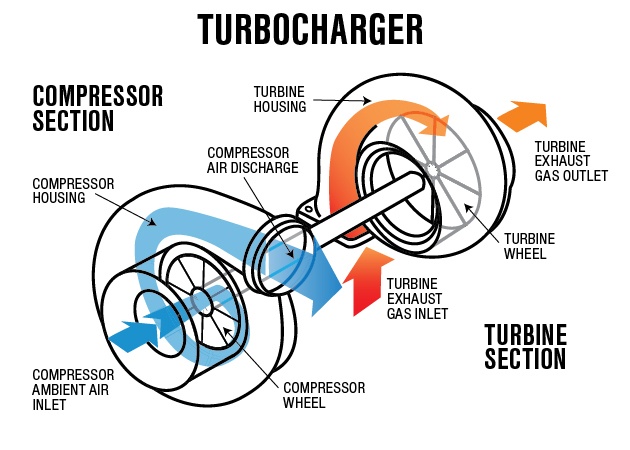
The turbocharger consists of a compressor and a turbine. The compressor and the turbine consist of impellers and are connected via a shaft.
The impeller in the turbine is responsible for the discharging of pressure in the engine and also sucks out the exhaust gas while the impeller of the compressor receives the exhaust gas. The compressor and turbine of the turbocharger are connected via a shaft which controls and enable smooth rotation.
HOW DOES IT OPERATE?
It operates with a simple principle. It uses the exhaust gas to drive the turbine which spins the compressor hence pushes extra air[oxygen,densed] into the cylinders,allowing them to burn more fuel each second.
The turbine and the compressor consist of impeller which are connected via a shaft that enables them spin alongside.
The turbine is connected to the exhaust manifold. When hot gases passes through the impellers of the turbine they rotate as well as the shaft hence causing the impellers of the compressor to rotate. As the impellers in the compressor of the turbocharger which is connected to the intake manifold rotates, it draws air into the engine and forces it into the cylinder through an heat exchanger.
Note:the heat exchanger is used to make the air cooled and denser.
WHERE CAN IT BE APPLIED
It can be installed in the otto cycle engines and Diesel cycle engines
LIKELY PROBLEM ENCOUNTERED
Grinding of shaft
seizing of shaft from rotating. This can lead to overheating of the turbocharger itself.
The late professor Stephen Hawking's final theory on the origin of the universe has been published today in the Journal of High Energy Physics. Hawking collaborated with Professor Thomas Hertog from KU Leuven on the paper which was submitted for publishing before Hawking's death in March this year.
The paper’s ideas are based on string theory, it predicts the universe is finite and that the universe's origin may, in fact, be far more simple than current theories relating to the Big Bang. Modern Big Bang theorists believe that the universe came into existence with a burst of inflation that started to occur just moments after the Big Bang itself.
It is thought that once this inflation begins the quantum effects can keep it going indefinitely. The part of the universe that we can observe is just a hospitable pocket where inflation has ended.
"The usual theory of eternal inflation predicts that globally our universe is like an infinite fractal, with a mosaic of different pocket universes, separated by an inflating ocean," said Hawking in an interview last autumn. "The local laws of physics and chemistry can differ from one pocket universe to another, which together would form a multiverse.
But I have never been a fan of the multiverse. If the scale of different universes in the multiverse is large or infinite the theory can't be tested." In their new paper, Hawking and Hertog say the eternal inflation model is wrong.
This is because Einstein's theory of general relativity breaks down on quantum scales. "The problem with the usual account of eternal inflation is that it assumes an existing background universe that evolves according to Einstein's theory of general relativity and treats the quantum effects as small fluctuations around this," said Hertog.
"However, the dynamics of eternal inflation wipes out the separation between classical and quantum physics. As a consequence, Einstein's theory breaks down in eternal inflation."
"We predict that our universe, on the largest scales, is reasonably smooth and globally finite. So it is not a fractal structure," said Hawking. Their latest research doesn’t disprove multiverses, but reduces them to a much smaller range.
This means the multiverse theory will be able to be tested by a larger range of physicists in the future.
Professor Hertog whose work has been supported by the European Research Council, already has plans to test it by looking for gravitational waves that could have been generated by eternal inflation.
Hertog first announced the new theory at a conference at the University of Cambridge in July of last year, organized on the occasion of Professor Hawking's 75th birthday.
The 20th century saw an increasing use of technology in the chair construction with such things as all-metal folding chairs, metal-legged chairs, the slumber chair, moulded plastic chair and ergonomic chairs.
Because of its used for various purposes, there are three (3) factors to consider when choosing an executive chair.
FORMS
Office chairs comes in several styles and forms to suit almost every need. The executive office chair which is more expensive than a basic chair features a more luxurious design and materials,its unique adjustable options for the whole body allows for more tailored comfort. Mostly its constructed with thickened padding for higher comfortability.
There's also task office chair which features a frame made from steel or plastic and typically includes arm rests and back support. The seat and back rest are upholstered with fabric to enhance comfort. The other forms are the swivel office chair which features controls that adjusts the height and the ergonomic chairs which reduces tension in the body, predominately in the back and the hips. It features an adjustable seat, arm and back height, as well as lumber support.
FEATURES
Features that are to be considered are as follows
Upholstery : office chairs come upholstered in a variety of materials and in different colours. The chair produced with Leather are usually more expensive.
Adjustable controls: look for a chair that offers controls for height, depth, tilt and arm rest, to enable adjusting of the chair to suit your needs for better comfort and body alignment.
Lumbar support: To reduce stress and strain on our back.
FUNCTIONS
Functions and comfort are very important when choosing an executive chair:
Cushioned seats: cushioning and paddling provides a contoured seat that can alleviate pressure associated with prolonged sitting.
Durability: The rate at which the chair would be used should and where it will be used should be consider. Factors for conference rooms differs from that an office.
Size: choose an office chair that suits your height and weight for proper support and comfort. If you have more weight or taller, a big and tall chair is designed with a generous seating area and higher adjustment.
Style: When choosing an office chair , the décor should be considered, also the arm style, upholstery material and base style to determine what best compliment your space.
Note: A great office chair can make a difference in getting through a long work day with ease and increased output efficiency.
Machines tends to fail or work below its required strength or capacity due to improper lubrication of the machine components. Many operators ignores the fact that friction exist thereby underestimating the importance of lubrication. Some do not know what lubrication means, its principle,the positives and negatives and why its necessary for it to be in check.
The techniques of using lubricants to reduce friction between surfaces is termed lubrication. This definition contains two main terms, lubricant and friction.
Understanding what friction is, will help us in the application of lubricants.
Friction is that which hinders a body from moving smoothly on the surface of another, a stationery and a moving part or two or moving parts. Friction has a role to play in machines but when it becomes excessive or when its not needed, damage will occur in the machine or its component. Effects like corrosion, overheating, wear and others have the possibility of occurring if its not lubricated.
To achieve reduced friction the lubricant which is the applied element must meet the following purposes.
It most be able to resist temperature at the extremes(freeze & boiling point) to retains its viscosity index.
The lubricant must be thick enough to seal and thin enough to minimize fluid friction
Forming a sliding seal between the moving surface
Cleaning function between the moving surface.
It must not have a vanish tendency
Lubricant are of various types and functions
Engine oil: lubricates the engine moving parts
Grease: used for bearings
Hydraulic oil: used for power steering of vehicles, excavators, industrial machineries etc.
Brake fluid: used in hydraulic brake and clutches
Transformer oil: used in oil filled transformers
Soluble oil: used in vehicles to regulate the boiling and freezing point of water
Solid lubricant(graphite)
WHAT IF I DO NOT LUBRICATE
Inadequate lubrication often produces excessive heat thus bearing failure and the heat build up lowers the viscosity of the lubricant. The thickness of the fluid film that separates the bearing surfaces might be reduced which may lead to metal to metal contact and bearing failure.
In internal combustion engines, lacks of lubrication causes metal to metal contact of the piston and the cylinder wall, improper sitting of the piston rings, over heating of valves,the connecting rod, cylinder head, cylinder wall, piston etc and as a result of this denotation occurs.
Note, proper lubrication enhances the life span of your bearings and machines, thus increased output efficiency. Time, money and manpower will be saved when proper lubrication are done.
Plants are device that make work easier and faster, they consist of several components coupled for the effectuation of power supply.
Plants generally are classified as
Domestic plants
Industrial plants
For the purpose of the topic, its classifications won't be explained,comment to inform me if you need it
Simple steps in engine or plant servicing
Warm the engine to reduce viscosity ie thickness of the lubricant
Remove the battery terminals
Drain the oil
Remove the oil filter (using filter clamp)
Filter clamp
Apply new oil filter and oil
Oil filter
Change fuel filter
Fuel filter
Bleed the engine ( slacking the nuts of the injector nozzle) then cranking the engine
For carburetors bleeding is not necessary
Apply new engine oil and gauge
N:B over gauging of oil weakens the rings of the piston
Change the oil filter if its blocked
In addition to start an engine the followings are compulsory
Check oil gauge
Check water level
Check gasoline level
Prime the engine
I know you have gotten the trick and knowledge immensely impacted... Good luck
Just in case you think the two stroke cycle engine will become obsolete, I advice you have a rethink because it will never be. The two stroke cycle engine is a type of internal combustion engine(I.C.E) that was developed to obtain high power output from a simple engine size and valve design via the movement of the piston during one crankshaft revolution. It works in spark ignition and combustion ignition engine. The general principle in which engines operate is based on
Induction
Compression
Power or expansion
Exhaust
However the two stroke cycle engine uses port(inlet port, transfer port and exhaust port) instead of valve to carryout the induction and exhaust operations. In every 360° rev, one cycle is completed i.e in every 180° rev, two strokes(exhaust and induction) followed by the compression and power stroke to complete the cycle.
In the two stroke cycle the charge is introduced through the inlet port from the carburetor into the crankcase to generate partial pressure on the charge, when the piston is at TDC . The downward movement of the piston causes the partially compressed charge to move into the cylinder through the transfer port. The compression stroke follows immediately to ignite the charge when the piston moves upward thereafter the power stroke causing the exhaust port to open for scavenging.
For the same size of flywheel the two stroke cycle engine runs smoother.
Theoretically the two stroke produces double the useful power to that of a four stroke engine with the same cylinder capacity
lubrication of oil and fuel mixture can be done with the ratio of 1:16 and 1:24
Less maintenance
Though they are not used for automobile due to mixed oil and fuel, over heating under heavy driving conditions and other factors but they are as important as the four stroke engine.
Mechanical engineering is a very wide discipline that, effectively, covers anything that moves. Its breadth is due, in part, from its need to cover the design and manufacture of anything and everything in a moving system.
This ranges from a system's smallest components to the completed, sometimes enormous, machine as a whole. Throughout history some innovations have come to define mechanics as we know it today, the following are no exception.
These engineering innovations range from the any one of the classical 'simple machine' to complex concepts such as flight. This list is far from exhaustive and in no particular order.
1. The Aeolipile Was an Early Steam Reaction Turbine
The Aeolipilewas the world's first rotating steam engine or more technically correct, a steam reaction turbine. It was devised by the great Heron of Alexandria in the 1st Century AD and described it in great detail in his book Pneumatica.
This relatively simple device works by heating a reservoir of water within the device to generating steam. The steam is then conducted through one of the copper supports to a pivoted brass sphere.
Once the steam reaches the sphere it escapes through one of two nozzles at the ends of two, small, opposingly pointing arms. The escaping steam generates thrust and causes the sphere to rotate.
The basic principle is simple but the device’s real genius is its bearings. Only one of the supported arms pass steam to the sphere (via a sleeve bearing).
This pushes the sphere against the other supporting ‘solid’ arm that also has a thrust bearing. The solid arm comprises of a conical point that bears against a matching indentation on the surface of the sphere. This combination holds the sphere in place whilst it rotates.
There are very few innovations in mechanical engineering that have had as much influence as the wheel. The modern world would look very different without them.
Wheels, technically the wheel and axle is one of the six simple machines as defined in antiquity and expanded during the Renaissance.
The first depictions of wheeled-vehicles appear on an earthenware Bronocice pot from Poland and dates to around 4000 BC. The pot clearly depicts a wagon of some kind with four wheels set on two axles.
The earliest actual evidence of a physical wheel-axle combination comes from Slovenia and is dated to around 3360-3030 BC.
Wheels literally changed the world and have been a constant feature of human transport devices the world over.
Windmills are incredibly ingenious devices that are able to convert wind power into useful mechanical work. This is achieved by using large ‘sails’, usually made of wood, imparts rotational force to the main shaft that in turn can be used to power a process, like grinding flour.
The Persians were some of the first people to harness the power of wind when they began building early forms of windmills in Iran and Afghanistan in around the 7th Century AD.
These early windmills consisted of sails radiating from a vertical axis within a building with two large openings for the inlet and outlet of wind diametrically opposite each other. The mills were used to directly drive single pairs of millstones without the use of gears.
They were one of the first means by which civilizations were able to directly replace human beings as the main source of power for a process.
Windmills would become increasingly widespread throughout Europe during the Middle Ages and stayed in use well into the 19th Century.
The development of steam power during the industrial revolution would spark the eventual decline of windmills.
Pulleys are one, or several wheels, on an axle or shaft that support the movement and a change of direction of a cable or belt (that is usually taut). They transfer power between the shaft and cable and provide an immense mechanical advantage for providing large forces ideal for lifting heavy objects.
Pulleys come in various types:-
- A fixed pulley has an axle mounted in bearings attached to a supporting structure
- Movable pulleys have axles mounted on movable blocks.
- Compound pulleys are a mixture of the above two. The perfect example is the block and tackle pulley system.
The pulley was identified by the great Heron of Alexandria as one of the six simple machines. Today pulleys are an integral part of many mechanical systems including fan belts, flag poles, and water wells.
Long before the Wright Brothers were even born, man has been trying to take to the air. One such lesser-known flight pioneer was Brother Eilmer. Eilmer was a monk from Malmesbury Abbey, England when he made an early attempt at flying in 1010 AD.
An account of the event can still be found in William of Malmesbury’s book Gesta Regum Angloru
It is said that he was inspired by the legend of Icarus to build a basic glider and attempt to fly. His glider was built from a wooden frame and either linen or parchment.
He would later launch himself from about 18 meters above ground level, glided 200 meters and subsequently panicked and crashed, breaking both his legs.
He returned to the drawing board and planned his next flight only to halted by an embargo from his Abbot to stop any further attempts.
Brother Eilmer’s desire to fly, and others that followed him, like the Ottoman Celebi to the great Leonardo da Vinci, would drive our understanding of flight and aerodynamics.
6. Steel
Steelhas been known about since the beginning of the Iron Age. But for most of this time, the quality of iron produced varied widely.
The first blast furnaces began appearing in China in around the 6th Century BC and would spread into Europe during the Middle Ages. By the 17th Century iron was, more or less, well understood and by the 19th Century production methods and quality were improved dramatically.
Early metallurgists realized that when iron gets very hot it begins to absorb carbon. This, in turn, reduces the melting point of iron as a whole and makes the final product brittle.
They soon realized that they needed to find a way of removing high carbon contents to make iron products less brittle.
In around 1050 AD the precursor to the modern Bessemer Process is developed. This process decarbonized the metal through repeated forging under a cold blast.
Although this process was far less efficient that Bessemer’s later development it would form one critical stage in the development of our knowledge of the metallurgy of iron and steel.
The most important development was made by Henry Bessemer in 1856. He managed to find a way of using oxygen to reduce the carbon content in steel, thus creating the modern steel industry.
7. Sailed Ships Opened Up the Oceans
The very first depiction of a sailed ship dates back to around 3300 BC in an Egyptian painting. These early boats featured a square sail as well as banks of oars.
As they were confined to the Nile River and depended on winds within the narrow channel it was vital to retain oars during times of insufficient wind speed.
This combination dominated early ships for centuries reaching heights in technological advancements with the triremes of the classical period.
The first sails were probably made of animal skins but these were replaced by woven reed mats and eventually cloth in predynastic Egypt.
Later, sails were made of woven flax fiber in Europe which is still used today though cotton has largely replaced it.
Sailed ships would enable mass exploration of the seas and open up new trade routes. They would, in effect, shrink the world and allow previously disconnect nations to exchange goods and knowledge.
They would also enable nations to expand their influence around the world and, in some cases, become the workhorses of empire.
Incentives like these would further drive advancement in ship technology and mechanical engineering to the present day.
The printing press was one of the most important inventions for mechanical engineering and the population at large. Johannes Gutenberg’s machine was groundbreaking in its own time and set the stage for enormous advancements made during the Renaissance and Industrial Revolution.
Movable type printing had been around for some time before Gutenberg, notably in China, but his device was the first to mechanize the process of applying text and images to paper en masse.
Gutenberg’s press was modeled on the ancient wine presses of the Mediterranean and in fact, was made from a modified wine press. It was also developed on the existing presses of the medieval period.
His press worked by rolling ink over a pre-arranged raised surface of movable text held within a wooden frame. This was then pressed against a sheet of paper to create a copy.
This process was vastly more efficient than other presses of the time not to mention the previous process of hand copying books.
The press would allow books to be produced more quickly, and, most importantly, cheaper, enabling more and more people to afford to buy them. This would mark a watershed in human and engineering history.
The invention of the pistonis widely credited to French physicist, Denis Papin in 1690 AD. His design for a steam piston engine was built upon by later inventors like Thomas Newcomen and James Watt during the 18th Century.
Its invention, along with other advancements in steam engine technology, would mark the ‘true’ beginning of the industrial revolution.
Pistons tend to be contained within a cylinder that is made air-tight by use of piston rings. In modern engines, the piston serves to transfer force from expanding gas in the cylinder into reciprocating motion on a crankshaft.
This process is effectively reversed when applied to pumps.
Today pistons are essential components in many reciprocating engines, pumps, compressors and other similar devices.
"Give me a place to stand, and I shall move the Earth with it' is a remark of Archimedes who formally stated the correct mathematical principle of levers" - Pappus of Alexandria.
The lever, yet another simple engine, consists of a beam (or rigid rod) pivoted on a fixed hinge or fulcrum. Levers are incredibly useful devices that can be used to provide mechanical advantage to move very heavy objects with relatively little effort, otherwise known as leverage.
Depending on where the fulcrum is located as well as the load and effort, levers can be divided into three types:-
- Class 1 levers are those where the fulcrum is located in the center of the beam. Examples include a seesaw or a crowbar.
- Class 2 levers are those where the load (resistance) is located in the middle. Examples include a wheelbarrow or brake pedal.
- Class 3 levers are those where the effort is located in the middle. Examples include tweezers or even your own jaw.
Levers are first identified in the works of Archimedes in the 3rd Century BC,
11. The Locomotive Revolutionized Transportation Forever
Richard Trevithick, in 1801-1804 built both the first steam carriage and an experimental steam locomotive in Pen-y-Darren, Wales, UK. He later sold the patent and in 1804 revised his original version to successfully carry 10 tons of iron, 5 wagons, 70 men for about 10 miles.
This trip took just over 4 hours meaning his locomotive clocked up an eye-watering 2.4 miles per hour. This made it the very first steam locomotive to produce actual practical work.
The locomotive would go on to literally transform the face of industry and transportation the world over.
The humble yet immensely important ramp, or inclined plane, is another of the fundamental six simple machines that allows heavy loads to be moved vertically with relatively little effort. They are widely used in many applications from loading goods into trucks to disabled access ramps.
Moving an object up an inclined plane requires less force than lifting it straight up at a cost of an increase in the distance moved. The mechanical advantage for ramps is equal to the ratio of the length of the sloped surface to the height it rises.
The screw and wedge are other simple machines that can be considered variations on the inclined plane or ramp rather than discrete forms.
Gears or cogwheels are integral components of any rotating machine that allow for the change in speed, torque or direction of any power source. They are one of the fundamental mechanical engineering innovations in history.
Any change in torque with the use of gears and cogwheels necessarily creates a mechanical advantage thanks to the phenomenon of the gear ratio.
A gear can mesh with a linear toothed part, called a rack, producing translation instead of rotation.
It is unclear exactly when gears and cogwheels were first invented but some credit Archimedes. Today, gears are present in many moving systems and machines from bicycles to ship engines.
The bearing is another fundamental machine element that has come to define mechanical engineering. These devices allow the constraint of relative motion in one direction or plane whilst simultaneously reducing friction between moving parts.
Bearings come in many shapes and sizes and range from components holding shafts or axles in place (plain bearing) to more complex systems like ball bearings.
Modern-day sophisticated bearings often demand the highest level of precision and quality in manufacturing.
15. The Wedge Is Great For Breaking Things
The wedge is another simple machine and fundamental innovation in mechanical engineering. They have been used since prehistorical times for activities like splitting logs (axes) or rocks (chisels).
Wedges are defined as movable inclined planes that can be used to separate two objects (or portions thereof), lifting objects or holding them in place via the application of force to the wide end. The wedge's shape, therefore, converts one input force into perpendicular forces 90 degrees to the inclined surfaces.
The mechanical advantage achieved by any wedge is dependent on the ratio of its length to thickness. In other words wide, short wedges require more force but produce a quicker result than a long, low angled wedge.
16. Electrical Motors Convert Electricity Into Motion
Motors are electronic machines that convert AC or DC electrical current into rotational movement. Most common electrical motors work through the interaction of a magnetic field and winding currents to generate a force.
The basic principle behind electric motors, Ampere's Force Law, was first described by Ampere in 1820 and was first demonstrated by Michael Faraday in 1821. One of the first practical motors was created by Hungarian physicist, Anyos Jedlik in 1828.
Motors are found in many applications around the world from industrial fans to power tools to computer disk drive.




.jpg)


