A

Sunday, June 10, 2018

THE FACTORS BEHIND POWER LOSS IN AN ENGINE

Most operators lacks the proper knowledge on how to use and maintain an engine. Knowing the requirements for an engine to produce power and other function are important factors that must be learned in engine maintenance.  

Humans are mostly ignorant of the sign of power loss that emanate from the engine even when they are sometimes pronounced. For an engine to produce or loss power there are four factors that must be consider


  • AIR
  • FUEL
  • COMPRESSION
  • SPARK PLUG
AIR
Generally, in the absent of air, combustion of fuel can not occur. The mixture of air and fuel, known as the charge is a major factor for an engine to produce power,in absential power can not be generated.
Air contains dust,dirt particles and other contaminants of which if drawn into the injector, it causes blockage of  the injector nozzle and the running jet of the carburetor. in cases like this, the air filter is applied to prevent the dirt and contaminant from flowing through to the mixing chamber.

The air filter when applied prevents dirt from flowing through. The prevented dirt thereby remains in the air filter and hence clogging follows.A clogged air filter makes the engine work harder to pull in air, and can restrict the maximum amount of air intake. Less air means less power. 

Problems like this can be easily fixed, either by cleaning or replacing. Be bold it does not require a tool.

Another factor under air is the THROTTLE CABLE or ACCELERATOR CABLE, over time, due to long usage the throttle cable may loose or break. Breakage or failure of the throttle cable affects the ability of the engine to produce power due to the inability of the cable to open the throttle usually a butterfly valve for air intake. 
The exhaust port is also one factor that reduces the power of an engine if not properly maintained. The burnt gases in the combustion chamber flows through the exhaust port to the surrounding. clogging occurs sometimes of which restricts the flow of burnt gas hence causing to engine more power to push it out. Also clogging of the catalytic converter and mufflers can reduce an engine performance.


FUEL
The fuel system will support the engine, if the fuel injector/carburetor and the fuel pump are in good condition. For injectors, the system can be clogged up when deposits are built up as a result of heat soak or bad fuel injected into the system, thereby causing improper air-fuel mixture ratio and misfiring of the engine.

 The pump which is the fuel metering system can wear or struggle overtime due to its inability to measure up to the demand of long distance travel and higher load. These are the major factors under fuel that causes an engine to loss power.

COMPRESSION
Improper sitting of the compression rings reduces the power of an engine. This occur over time as a result of worn out component of the engine and this allows leakage of charge between the piston and the cylinder wall into the crankcase[blow-by]. That means pressure lost,compression lost and hence power loss.

Another factor is deposits on the valve sitting and improper arrangement of the timing belt which controls the movement of the camshaft and crankshaft as related to the valves. These effect on the valve cause low compression,additional restriction for the charge to come by and back firing. When these are detected,then there is every tendency that there will be loss of power in the engine.


SPARK PLUG
The spark plug supplies the spark that is needed for combustion to be initiated. Deposits from lubricants,fuel and carbon deposits causes inconsistent spark plug firing. Maintaining a high spark, ensures high power output but low spark as a result of deposits will result to loss of power.

NB:
 Carbon deposit on the cylinder wall or the piston can create hot spot and these hot spot will result to engine knock. sometimes it will retard the ignition timing to reduce the possibilities of knocking if the engine is capable. These process of retarding the ignition timing, power is lost in the engine. Proper lubrication plays an important role in this.


Saturday, June 2, 2018

THE TURBOCHARGER SERIES


The value of the turbo charger in an automobile is unknown to a few engineers and its users, because they lack the proper knowledge on these points of the component itself.


Image result for turbocharger
http://d3e98kcom2u4ch.cloudfront.net/wp-content/uploads/oldblog/2016/09/turbocharger-operation-diagram.jpg


  • What is the value of the turbocharger?
  • What is it made of?
  • How does it work?
  • Where can it applied?
  • Likely problem encountered


Ignorantly we think the main reason motor A generates more power,higher velocity,consumes less fuel, sometimes environmental friendly than motor B is because of the engine structure or size. But there is one way to improve an engine which is the turbocharger.

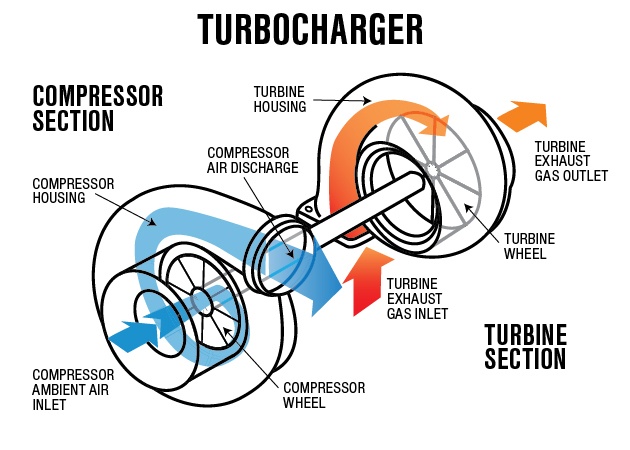
The turbocharger is an exhaust-gas driven component of an engine that increases the volumetric efficiency of air in an engine in order to increase its power.  It consist of a casing,impellers and shaft.

Generally, the charge[mixture of fuel and air] that flows into the combustion chamber produces the torque that turns the engine. For the engine to produce or generate more power there are two alternatives, firstly, is to increase the size of the engine[the cylinder block,cylinder wall,pistons] so that the total volume of intake increases. The second option is to generate air externally.

Several medium can aid the supply/generating of air into the engine, of which, are the supercharging,turbocharging and others.The turbocharger is of advantage over the supercharger because it uses the exhaust gas of the engine to power the impellers thereby generating the air needed whereas the supercharger uses the crankshaft of the engine connected via belts to power it blades.

Some might ask, of what importance is the turbocharger aside increasing the torque that turns an  engine, ok, here it is

  • It reduces the stress of an engine by decarbonizing
  • It cleans the combustion chambers
  • It adds 20hp to the engine
  • The turbo charger acts like a silencer
  • It reduces the stress of the valve
  • It increases the power of the engine with less fuel

WHAT IS IT MADE OF?

The turbocharger consists of a compressor and a turbine. The compressor and the turbine consist of impellers and are connected via a shaft.

The impeller in the turbine is responsible for the discharging of pressure in the engine and also sucks out the exhaust gas while the impeller of the compressor receives the exhaust gas. The compressor and turbine of the turbocharger are connected via a shaft which controls and enable smooth rotation.


HOW DOES IT OPERATE? 

It operates with a simple principle. It uses the exhaust gas to drive the turbine which spins the compressor hence pushes extra air[oxygen,densed] into the cylinders,allowing them to burn more fuel each second.

The turbine and the compressor consist of impeller which are connected via a shaft that enables them spin alongside.
The turbine is connected to the exhaust manifold. When hot gases passes through the impellers of the turbine they rotate as well as the shaft hence causing the impellers of the compressor to rotate. As the impellers in the compressor of the turbocharger which is connected to the intake manifold rotates, it draws air into the engine and forces it into the cylinder through an heat exchanger.
Note:the heat exchanger is used to make the air cooled and denser.


WHERE CAN IT BE APPLIED

It can be installed in the otto cycle engines and Diesel cycle engines


LIKELY PROBLEM ENCOUNTERED

  • Grinding of shaft
  • seizing of shaft from rotating. This can lead to overheating of the turbocharger itself.

Tuesday, May 8, 2018

LATE PROFESSOR STEPHEN HAWKINGS FINAL THEORY ON THE ORIGIN OF THE UNIVERSE HAS BEEN PUBLISHED BY PROFESSOR THOMAS HERTOG


biography.com
The late professor Stephen Hawking's final theory on the origin of the universe has been published today in the Journal of High Energy Physics. Hawking collaborated with Professor Thomas Hertog from KU Leuven on the paper which was submitted for publishing before Hawking's death in March this year.
The paper’s ideas are based on string theory, it predicts the universe is finite and that the universe's origin may, in fact, be far more simple than current theories relating to the Big Bang. Modern Big Bang theorists believe that the universe came into existence with a burst of inflation that started to occur just moments after the Big Bang itself.


It is thought that once this inflation begins the quantum effects can keep it going indefinitely. The part of the universe that we can observe is just a hospitable pocket where inflation has ended.
"The usual theory of eternal inflation predicts that globally our universe is like an infinite fractal, with a mosaic of different pocket universes, separated by an inflating ocean," said Hawking in an interview last autumn. "The local laws of physics and chemistry can differ from one pocket universe to another, which together would form a multiverse.
But I have never been a fan of the multiverse. If the scale of different universes in the multiverse is large or infinite the theory can't be tested." In their new paper, Hawking and Hertog say the eternal inflation model is wrong.
This is because Einstein's theory of general relativity breaks down on quantum scales. "The problem with the usual account of eternal inflation is that it assumes an existing background universe that evolves according to Einstein's theory of general relativity and treats the quantum effects as small fluctuations around this," said Hertog.
"However, the dynamics of eternal inflation wipes out the separation between classical and quantum physics. As a consequence, Einstein's theory breaks down in eternal inflation."
"We predict that our universe, on the largest scales, is reasonably smooth and globally finite. So it is not a fractal structure," said Hawking. Their latest research doesn’t disprove multiverses, but reduces them to a much smaller range.
This means the multiverse theory will be able to be tested by a larger range of physicists in the future.
Professor Hertog whose work has been supported by the European Research Council, already has plans to test it by looking for gravitational waves that could have been generated by eternal inflation.
Hertog first announced the new theory at a conference at the University of Cambridge in July of last year, organized on the occasion of Professor Hawking's 75th birthday.
The research by Hawking and Hertog has been published in the Journal of High Energy Physics, and can be read in full on arXiv.


THE BEST OPTION TO ERGONOMIC : THE EXECUTIVE OFFICE CHAIR

The 20th century saw an increasing use of technology in the chair construction with such things as all-metal folding chairs, metal-legged chairs, the slumber chair, moulded plastic chair and ergonomic chairs.

Because of its used for various purposes, there are three (3) factors to consider when choosing an executive chair.


  • FORMS

Office chairs comes in several styles and forms to suit almost every need. The executive office chair which is more expensive than a basic chair features a more luxurious design and materials,its unique adjustable options for the whole body allows for more tailored comfort. Mostly its constructed with thickened padding for higher comfortability.
There's also task office chair which features a frame made from steel or plastic and typically includes arm rests and back support. The seat and back rest are upholstered with fabric to enhance comfort. The other forms are the swivel office chair which features controls that adjusts the height and the ergonomic chairs which reduces tension in the body, predominately in the back and the hips. It features an adjustable seat, arm and back height,  as well as lumber support.


  • FEATURES
Features that are to be considered are as follows
Upholstery : office chairs come upholstered in a variety of materials and in different colours. The chair produced with Leather are usually more expensive.
Adjustable controls: look for a chair that offers controls for height, depth, tilt and arm rest, to enable adjusting of the chair to suit your needs for better comfort and body alignment.
Lumbar support: To reduce stress and strain on our back.


  • FUNCTIONS
Functions and comfort are very important when choosing an executive chair:
Cushioned seats: cushioning and paddling provides a contoured seat that can alleviate pressure associated with prolonged sitting.
Durability: The rate at which the chair would be used should and where it will be used should be consider. Factors for conference rooms differs from that an office.
Size: choose an office chair that suits your height and weight for proper support and comfort. If you have more weight or taller, a big and tall chair is designed with a generous seating area and higher adjustment.
Style: When choosing an office chair , the décor should be considered,  also the arm style, upholstery material and base style to determine what best compliment your space.
Note: A great office chair can make a difference in getting through a long work day with ease and increased output efficiency.
Executive office chair

CONSEQUENCES OF IMPROPER LUBRICATION

Machines tends to fail or work below its required strength or capacity  due to improper lubrication of the machine components. Many operators ignores the fact that friction exist thereby underestimating the importance of lubrication. Some do not know what lubrication means, its principle,the positives and negatives and why its necessary for it to be in check.


The techniques of using lubricants to reduce friction between surfaces is termed lubrication. This definition contains two main terms, lubricant and friction.
Understanding what friction is, will help us in the application of lubricants.

 Friction is that which hinders a body from moving smoothly on the surface of another, a stationery and a moving part or two or moving parts. Friction has a role to play in machines but when it becomes excessive or when its not needed,  damage will occur in the machine or its component. Effects like corrosion, overheating, wear and others have the possibility of occurring if  its not lubricated.

To achieve reduced friction the lubricant which is the applied element must meet the following purposes.

  • It most be able to resist temperature at the extremes(freeze & boiling point) to retains its viscosity index.
  • The lubricant must be thick enough to seal and thin enough to minimize fluid friction
  • Forming a sliding seal between the moving surface
  • Cleaning function between the moving surface.
  • It must not have a vanish tendency
Lubricant are of various types and functions

  • Engine oil: lubricates the engine moving parts
  • Grease: used for bearings
  • Hydraulic oil: used for power steering of vehicles, excavators, industrial machineries etc.
  • Brake fluid: used in hydraulic brake and clutches  
  • Transformer oil: used in oil filled transformers
  • Soluble oil: used in vehicles to regulate the boiling and freezing point of water
  • Solid lubricant(graphite)
WHAT IF I DO NOT LUBRICATE
Inadequate lubrication often produces excessive heat thus bearing failure and the heat build up lowers the viscosity of the lubricant. The thickness of the fluid film that separates the bearing surfaces might be reduced which may lead to metal to metal contact and bearing failure.

In internal combustion engines,  lacks of  lubrication causes metal to metal contact of the piston and the cylinder wall, improper sitting of the piston rings, over heating of valves,the connecting rod, cylinder head, cylinder wall, piston etc and as a result of this denotation occurs.

Note,  proper lubrication enhances the life span of your bearings and machines, thus increased output efficiency. Time, money and manpower will be saved when proper lubrication are done.


Photo credit: www.ircm.com.pk


ENGINE SERVICING MADE EASY: GUIDELINES TO PROPER MAINTENANCE OF PLANTS


Plants are device that make work easier and faster, they consist of several components coupled for the effectuation of power supply.
Plants generally are classified as

  • Domestic plants
  • Industrial plants
For the purpose of the topic, its classifications won't be explained,comment to inform me if you need it

Simple steps in engine or plant servicing

  •  Warm the engine to reduce viscosity ie thickness of the lubricant
  • Remove the battery terminals
  • Drain the oil
  • Remove the oil filter (using filter clamp)
               
Filter clamp

  • Apply  new oil filter and oil
Oil filter

  • Change fuel filter
         
Fuel filter

  • Bleed the engine ( slacking the nuts of the injector nozzle) then cranking the engine
  • For carburetors bleeding is not necessary
  • Apply new engine oil and gauge 
N:B over gauging  of oil weakens the rings of the piston
Change the oil filter if its blocked

In addition to start an engine the followings are compulsory
  • Check oil gauge
  • Check water level
  • Check gasoline level
  • Prime the engine 
I know you have gotten the trick and knowledge immensely impacted... Good luck

FOREMOST THEORY ON CONTROL VALVE